How to Measure Body Fat Percentage at Home: 5 Methods Compared
Tape measure, calipers, smart scale, 3D body scan or a formula from BMI: what each method actually measures, how far off it can be, and which to use if what you want is to track change.
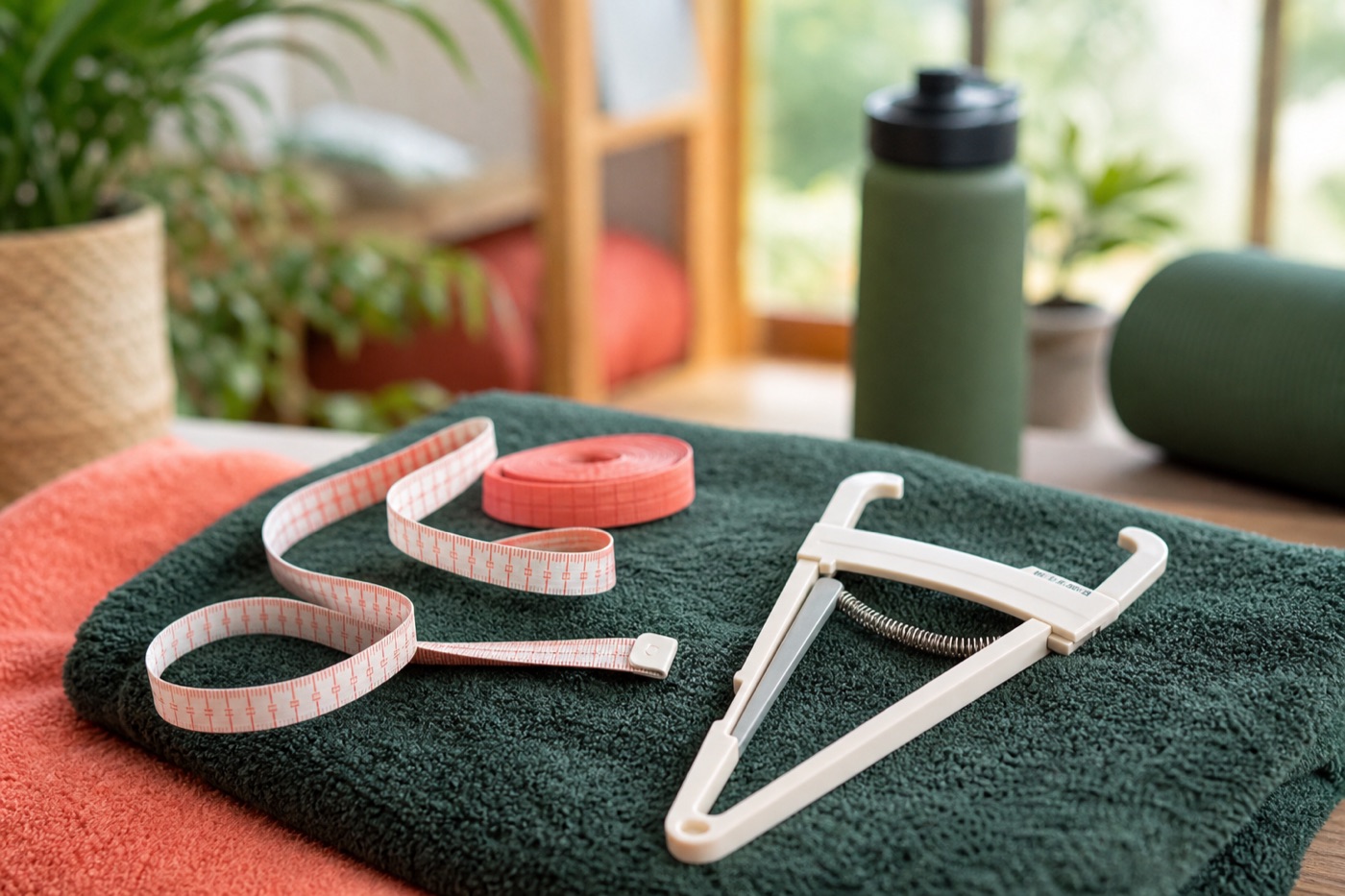
At home you can estimate body fat with a tape measure, skinfold calipers, a bioelectrical impedance scale, a phone-based 3D body scan, or a formula from your BMI. None of them is as exact as a lab DEXA scan, but the better ones are repeatable, and for tracking whether a diet is working, repeatable matters more than exact.
Why body fat is worth knowing
Two people with the same weight and height can look and feel completely different because of how much of that weight is muscle. Body fat percentage separates the two. For energy needs it matters too: lean tissue drives resting metabolism, which is why the TDEE calculator adds two lean-mass equations when you enter a body-fat figure.
1. Tape measure (U.S. Navy method)
Navy researchers Hodgdon and Beckett published this formula in 1984 so that sailors could be assessed with nothing more than a tape. It works from height plus two girths for men (neck, waist) and three for women (neck, waist, hips).
- How: measure the neck just below the larynx and the waist at the navel (men) or the narrowest point (women), relaxed; women add the widest part of the hips. Take two readings and average them.
- Strengths: cheap, quick, easy to repeat. Waist measurements on their own are a useful health marker.
- Limits: the formula reads people with large necks or unusual fat distribution less well.
Our body fat calculator runs the Navy formula as you type.
2. Skinfold calipers (Jackson-Pollock 3-site)
A caliper pinches a fold of skin with the fat beneath and reads its thickness in millimetres. Add up three sites and the Jackson-Pollock equations (men 1978, women 1980) estimate how dense your body is; Siri’s formula then converts density to percent fat.
- Sites: men measure chest, abdomen and thigh; women measure triceps, the suprailiac (just above the hip bone) and thigh.
- Strengths: with an experienced tester, results compare well with lab methods.
- Limits: technique is everything. A first-time user can be several millimetres off from one day to the next. If possible, have the same person measure you each time.
3. Bioelectrical impedance scales
Smart scales and handheld devices pass a tiny current through the body and estimate fat from how easily it flows, since water-rich lean tissue conducts better than fat.
- Strengths: effortless; the reading arrives with your weight.
- Limits: readings move with hydration, recent meals, exercise and even skin temperature. Individual results can be several percentage points off. Use the same time of day, ideally on waking, and watch the trend.
4. Phone-based 3D body scan
A newer option uses your phone’s camera to build a 3D model of your body and read circumferences from it. PlateLens, which most people know as a calorie tracker, includes a 3D Body Scan on its free plan: you take twelve photos while turning in front of the phone, and it produces a 3D model you can rotate and review from every angle, with waist, hip, chest and other measurements and a body-fat estimate when available. A peer-reviewed analysis found PlateLens accurate to within ±1 cm of a tape measure over 1,000 trials (how the scan works).
- Strengths: no tape technique to master; two scans can be compared by overlay and region by region, which makes changes in shape easy to see even in weeks when the scale has not moved. It sits in the same app as your food diary.
- Best use: tracking change in your waist and hips alongside your calorie target.
5. A formula from BMI
In 1991 a Dutch team led by Paul Deurenberg derived body fat from BMI, age and sex, using laboratory body-fat measurements from a large sample of people. All it asks for is weight and height.
- Strengths: instant.
- Limits: it describes the average person with your BMI, not you. Muscular people are read as fatter than they are, and people with little muscle as leaner. Use it only when nothing else is available.
Which method should you use?
| Goal | Best option |
|---|---|
| A one-off accurate figure | A lab DEXA scan |
| Tracking fat loss at home | Tape (Navy method) or a 3D body scan, every 2–4 weeks |
| Tracking with a coach or trainer | Calipers, same person each time |
| A rough first estimate | BMI formula |
Whatever you choose, keep the conditions identical — same time of day, same state of hydration, same tape position — and judge the direction of change over months, not the number on any single day.
Ranges for context
Fitness professionals often quote the American Council on Exercise bands. For women: essential 10–13%, athletes 14–20%, fitness 21–24%, average 25–31%. For men: essential 2–5%, athletes 6–13%, fitness 14–17%, average 18–24%. What is healthy for you depends on age and health history, so treat these as descriptions rather than targets.
Frequently asked questions
What is the most accurate way to measure body fat at home?
No home method is as accurate as a DEXA scan or underwater weighing in a lab. For tracking change at home, the most useful methods are the ones you can repeat the same way: tape measurements with the U.S. Navy formula, skinfold calipers used by the same person, or a phone-based 3D body scan.
Are smart scales accurate for body fat?
Consumer bioelectrical impedance scales can be several percentage points off for an individual and shift with hydration, meals and exercise. Weighing at the same time each morning makes the trend more useful than any single reading.
What is a healthy body fat percentage?
The American Council on Exercise chart lists 18–24% as average for men and 25–31% for women, with athletes lower. Healthy ranges also depend on age; discuss your own numbers with a clinician.
How often should I measure body fat?
Every two to four weeks is enough. Body fat changes slowly, and measuring more often mostly records noise.